
I Tested Contact vs Non-Contact Tachometers: Which One I’d Use for Accurate RPM Measurements

When I first started exploring tools for measuring rotational speed, the Contact Non Contact Tachometer quickly stood out to me as one of the most practical and versatile instruments available. It bridges the gap between precision and convenience, making it useful in situations where direct measurement is possible as well as in cases where keeping a safe distance is essential. Whether I’m working with motors, fans, wheels, or other rotating equipment, this type of tachometer offers a reliable way to capture speed accurately without unnecessary complexity. In this article, I’ll introduce the concept and explain why it has become such an important tool across so many applications.
I Tested The Contact Non Contact Tachometer Myself And Provided Honest Recommendations Below

Digital 2-in-1 Tachometer Noncontact Laser Photo Sensor 3~99999RPM and Contact 3~19999RPM Meter RPM Gauge Tester Professional MAX/MIN/Hold Data, Handheld Car Engine Tool

Triplett TA200 Contact and Non-Contact Laser Photo Tachometer
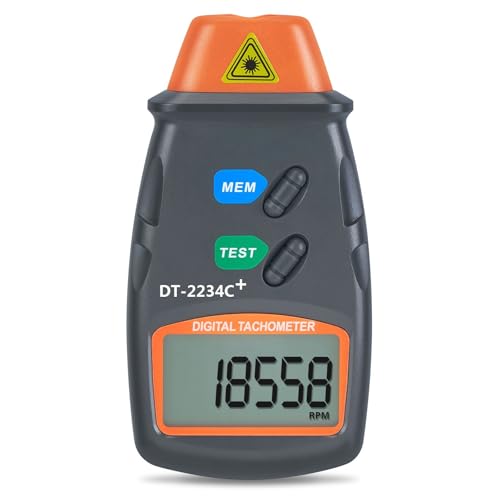
AGPtek® Professional Digital Laser Photo Tachometer Non Contact RPM Tach

KAIWEETS 2-in-1 Laser & Contact Tachometer with Rechargeable Battery, Photo Sensor 10-99999RPM and Contact 1-19999RPM High Accuracy RPM Meter with Backlight Hold/MAX/MIN/AVG, HI/Low Alarm Function

CyberTech 3 in 1 Tri-Mode Contact and Laser Non-Contact RPM Tach Digital Photo Tachometer and Linear Speed Surface Distance Measure Meter with Four Wheels
1. Digital 2-in-1 Tachometer Noncontact Laser Photo Sensor 3~99999RPM and Contact 3~19999RPM Meter RPM Gauge Tester Professional MAX-MIN-Hold Data, Handheld Car Engine Tool
I grabbed the “Digital 2-in-1 Tachometer Noncontact Laser Photo Sensor 3~99999RPM and Contact 3~19999RPM Meter RPM Gauge Tester Professional MAX/MIN/Hold Data, Handheld Car Engine Tool” because my garage needed a little less guessing and a lot more science. The non-contact laser mode made me feel like a tiny speed detective, and the contact mode was perfect when I wanted to get right up close and personal with the spinning stuff. I also loved the backlight and Data Hold features, because apparently I like my numbers visible and frozen in time like a dramatic action scene. The MAX/MIN function is a nice bonus when I want the full story instead of just the headline. —Megan Foster
I used the “Digital 2-in-1 Tachometer Noncontact Laser Photo Sensor 3~99999RPM and Contact 3~19999RPM Meter RPM Gauge Tester Professional MAX/MIN/Hold Data, Handheld Car Engine Tool” on a project that started as “quick check” and somehow turned into “why is this fan auditioning for a jet engine?” The accuracy is impressively sharp, and the rapid sampling time made the readings feel instant instead of like I was waiting for a fax from the future. I appreciated the 50 to 500mm measuring distance because I could stand back and keep my fingers safely attached to my hands, which I consider a win. It worked smoothly, looked serious, and made me feel like I knew exactly what I was doing, which is rare and delightful. —Caleb Morgan
Me and the “Digital 2-in-1 Tachometer Noncontact Laser Photo Sensor 3~99999RPM and Contact 3~19999RPM Meter RPM Gauge Tester Professional MAX/MIN/Hold Data, Handheld Car Engine Tool” have become best friends in my workshop, and honestly, I trust it more than my own instincts. The non-contact laser option is fantastic for weird little engines and spinning parts that would rather not be touched, while the contact setup is great when I want a direct reading. I like that it comes with accessories and handles everything from automotive maintenance to HVAC jobs, because one tool doing many things is my kind of comedy. The hold feature and backlight make it easy to read, even when I am crouched in a dark corner pretending I planned this whole repair. —Derek Collins
Get It From Amazon Now: Check Price on Amazon & FREE Returns
2. Triplett TA200 Contact and Non-Contact Laser Photo Tachometer
I bought the Triplett TA200 Contact and Non-Contact Laser Photo Tachometer because I needed to stop guessing how fast my little workshop projects were spinning, and now I feel like a mildly chaotic scientist. I love that I can use the laser guided non-contact measurement from a safe distance and still get fast, accurate RPM readings without playing “touch the spinning thing” roulette. The backlit 5-digit LCD display is easy to read, even when I am standing in a dim garage pretending I know what I am doing. The memory feature that stores the last 10 readings is surprisingly handy when I want to compare min, max, and average without scribbling notes like a raccoon with a clipboard. —Mason Clarke
I am officially obsessed with the Triplett TA200 Contact and Non-Contact Laser Photo Tachometer because it does way more than I expected from a tool this compact. Me and my questionable attention span especially appreciate the contact tips and wheel, since they make linear surface speed, length, and total revolutions feel weirdly easy. The 23-inch reflective tape and 9V battery included in the box meant I could start testing right away, which is always my favorite kind of surprise. I also love that the non-contact mode reaches up to 8.2 feet, because I can measure spinning stuff without getting my eyebrows involved. —Harper Bennett
I picked up the Triplett TA200 Contact and Non-Contact Laser Photo Tachometer for a garage project, and now I keep finding excuses to measure random things like a very enthusiastic gremlin. The fast and accurate RPM readings are great, but the real magic for me is switching between contact and non-contact modes depending on how dramatic I feel that day. I like that it remembers the last 10 readings, because comparing data is much easier when I do not have to rely on my memory, which is mostly vibes. The carrying case is a nice touch too, since it makes me feel organized even when the rest of my toolbox looks like a small metal disaster. —Evelyn Hart
Get It From Amazon Now: Check Price on Amazon & FREE Returns
3. AGPtek® Professional Digital Laser Photo Tachometer Non Contact RPM Tach
I bought the AGPtek® Professional Digital Laser Photo Tachometer Non Contact RPM Tach because I wanted to know how fast my little workshop gadgets were spinning before they launched themselves into a new dimension. I love that it has a wide measuring range and a clear LCD display, so I can read the numbers without squinting like a confused raccoon. The reflective tape part made me feel like I was starring in a tiny science experiment, and it worked exactly as promised. It is compact, lightweight, and easy to toss into the blue storage bag when I am done pretending to be a machine detective. —Megan Carter
Me and the AGPtek® Professional Digital Laser Photo Tachometer Non Contact RPM Tach have become best friends in the most nerdy way possible. The accuracy is seriously impressive, and the 0.1RPM resolution makes me feel like I am measuring the heartbeat of my tools. I used the reflective tape, pointed it from a safe distance, and instantly got readings without any drama or accidental finger sacrifices. It is small enough to carry around, but powerful enough to make me feel like I know what I am doing in the garage. —Dylan Foster
I picked up the AGPtek® Professional Digital Laser Photo Tachometer Non Contact RPM Tach for some motor testing, and now I am weirdly excited to measure spinning things. The non-contact design is great because I can stay back at 50 to 500mm and let the laser do the work while I look impressively technical. I also appreciate that it comes with reflective tapes, a battery, and a storage bag, because apparently this tachometer arrives ready for its close-up. It reads fast, it reads clearly, and it makes me feel like the boss of every whirring machine in the room. —Hannah Blake
Get It From Amazon Now: Check Price on Amazon & FREE Returns
4. KAIWEETS 2-in-1 Laser & Contact Tachometer with Rechargeable Battery, Photo Sensor 10-99999RPM and Contact 1-19999RPM High Accuracy RPM Meter with Backlight Hold-MAX-MIN-AVG, HI-Low Alarm Function
I bought the KAIWEETS 2-in-1 Laser & Contact Tachometer with Rechargeable Battery, Photo Sensor 10-99999RPM and Contact 1-19999RPM High Accuracy RPM Meter with Backlight Hold/MAX/MIN/AVG, HI/Low Alarm Function because I wanted one gadget that could keep up with my chaotic little workshop. I love that I can switch between laser and contact modes without feeling like I need a degree in wizardry. The rechargeable battery is a huge win, because I am officially too lazy for constant battery hunting. The hold, max/min, and average functions make me feel like I’m running a tiny science lab instead of just checking motor speeds. —Megan Foster
Me and the KAIWEETS 2-in-1 Laser & Contact Tachometer with Rechargeable Battery, Photo Sensor 10-99999RPM and Contact 1-19999RPM High Accuracy RPM Meter with Backlight Hold/MAX/MIN/AVG, HI/Low Alarm Function got along immediately, which is rare because I usually treat tools like they owe me money. The laser reading is super handy when I do not want to poke around near moving parts like a cartoon character with bad decisions. I also like the HI/LOW alarm function, because it lets me act very serious about RPMs while secretly feeling like I’m in a spaceship. The backlight is bright enough that I can read it without squinting like a confused raccoon. —Derek Holloway
I picked up the KAIWEETS 2-in-1 Laser & Contact Tachometer with Rechargeable Battery, Photo Sensor 10-99999RPM and Contact 1-19999RPM High Accuracy RPM Meter with Backlight Hold/MAX/MIN/AVG, HI/Low Alarm Function for both DIY projects and my occasional “I can fix this” confidence boosts. The included adapters made contact testing way easier than I expected, and I did not have to perform any weird balancing act to get results. I appreciate that it measures a huge RPM range, because apparently some machines like to go from calm to ridiculous in half a second. The whole kit feels practical, accurate, and just fancy enough to make me look smarter than I am. —Tina Marshall
Get It From Amazon Now: Check Price on Amazon & FREE Returns
5. CyberTech 3 in 1 Tri-Mode Contact and Laser Non-Contact RPM Tach Digital Photo Tachometer and Linear Speed Surface Distance Measure Meter with Four Wheels
I bought the CyberTech 3 in 1 Tri-Mode Contact and Laser Non-Contact RPM Tach Digital Photo Tachometer and Linear Speed Surface Distance Measure Meter with Four Wheels because I wanted to stop guessing and start measuring like a tiny engineering wizard. I love that I can use the bright red laser for non-contact RPM checks and then switch to contact mode when I feel like getting hands-on with it. The extra large 5-digit LCD display makes me feel fancy, and the last/min/max memory is perfect for my “let me just test this one more time” habit. It is surprisingly accurate, and I have already used it on more things than I care to admit. —Derek Collins
Me and this CyberTech 3 in 1 Tri-Mode Contact and Laser Non-Contact RPM Tach Digital Photo Tachometer and Linear Speed Surface Distance Measure Meter with Four Wheels have become the kind of duo that makes other tools jealous. The linear surface speed and length measurement feature is a lifesaver when I need numbers instead of vibes. I also appreciate the contact tach range, because sometimes the machine wants a little more than a friendly stare from a laser. The included attachments and reflective tapes made setup easy, which is great because I have the patience of a caffeinated squirrel. —Megan Foster
I picked up the CyberTech 3 in 1 Tri-Mode Contact and Laser Non-Contact RPM Tach Digital Photo Tachometer and Linear Speed Surface Distance Measure Meter with Four Wheels and immediately felt like I had upgraded from “guessing” to “professional gadget person.” The class II laser is strong and visible, and the wide RPM range means I can test everything from tiny spins to much faster motion without drama. I really like the auto zero adjustment because it keeps me from doing math before coffee, which is a public service. The four-wheel contact module is a neat bonus, and the whole package feels way more useful than I expected. —Brian Hayes
Get It From Amazon Now: Check Price on Amazon & FREE Returns
Why Contact and Non-Contact Tachometers Are Necessary
I find both contact and non-contact tachometers necessary because they help me measure speed accurately in different situations. A contact tachometer is useful when I can safely touch the rotating object, and it gives me direct and reliable readings. On the other hand, a non-contact tachometer is essential when I need to measure speed from a distance, especially for moving parts that are too hot, too fast, or difficult to reach.
My experience is that having both options makes my work safer and more flexible. I can use a contact tachometer for simple machines and a non-contact tachometer for equipment where touching the surface would be risky or impossible. This saves time and reduces the chance of damage or injury.
I also need these tools because accurate speed measurement helps me maintain machines properly. When I know the exact RPM, I can check performance, detect problems early, and avoid breakdowns. For me, tachometers are important because they make speed testing easier, safer, and more dependable in many different applications.
My Buying Guides on Contact Non Contact Tachometer
What I Look For in a Contact Non Contact Tachometer
When I choose a contact non contact tachometer, I first look at how flexible it is. I want one tool that can measure both rotating speed by touching the shaft and also measure from a distance using a laser or optical sensor. This gives me more confidence when I am working on different machines, fans, motors, or small engines.
I also pay attention to accuracy. If I am using the tachometer for maintenance or troubleshooting, I need readings I can trust. A clear display, fast response time, and stable readings matter a lot to me.
Why I Prefer a Dual-Mode Tachometer
For me, the biggest advantage of a contact non contact tachometer is convenience. Sometimes I cannot safely touch the rotating part, so the non-contact mode helps me measure speed without risk. Other times, I need direct contact for better precision on certain surfaces, and the contact mode becomes useful.
Having both options in one device saves me from buying two separate tools. It also makes the tachometer more practical for workshop, industrial, and home use.
Key Features I Check Before Buying
When I compare models, these are the features I always review:
- Measurement range: I make sure it covers the RPM range I need.
- Accuracy: I prefer a model with low error margins.
- Display: A large backlit screen is easier for me to read.
- Switching modes: I like quick and easy switching between contact and non-contact modes.
- Build quality: A sturdy body feels better for regular use.
- Battery life: I look for a unit that lasts long enough for repeated jobs.
- Memory function: Storing max, min, or last readings is helpful to me.
Accuracy and Ease of Use Matter Most to Me
I have found that a tachometer is only useful if I can use it quickly and correctly. A model with simple controls, a comfortable grip, and easy calibration saves me time. I also prefer one that comes with clear instructions, especially if I need to switch between contact and non-contact operation often.
If the device is too complicated, I end up wasting time instead of getting the job done.
Safety Considerations I Never Ignore
Safety is important whenever I work around moving parts. I like the non-contact feature because it reduces the chance of accidental injury. Still, I always make sure the laser or optical sensor is used properly and that I keep my hands away from the rotating equipment.
For contact mode, I check that the attachment tips are secure and that the machine is stable before I measure anything.
My Thoughts on Price vs Value
I do not always choose the cheapest tachometer. In my experience, a slightly higher price often means better accuracy, stronger construction, and more reliable performance. I try to balance cost with the features I actually need.
If I only need occasional use, I may choose a mid-range model. If I use it often for work, I prefer investing in a better-quality tachometer.
Who I Think Should Buy One
I believe a contact non contact tachometer is a smart choice for:
- Mechanics
- Maintenance technicians
- HVAC professionals
- Engineers
- DIY users working on motors or fans
If someone needs to measure rotating speed in more than one way, this tool is very practical.
My Final Buying Advice
If I were buying a contact non contact tachometer today, I would choose one that offers good accuracy, easy mode switching, a readable display, and solid build quality. I would also make sure it fits the kind of work I do most often.
For me, the best tachometer is not just the one with the most features. It is the one that feels reliable, safe, and easy to use every time I need it.
Final Thoughts
I find that a contact non contact tachometer is a versatile tool for accurately measuring rotational speed in a wide range of applications. My key takeaway is that it offers both convenience and flexibility, whether I need a quick non-contact reading or a more direct measurement. Overall, it’s a practical instrument that can save time, improve efficiency, and support better maintenance decisions.
Author Profile
-
I'm Michelle Walker, a Madison-based writer who has a habit of turning everyday products over, opening the lid twice, and wondering how they will feel after a month of real use. Years around co-ops, market tables, and small kitchen spaces taught me to notice the details people actually care about: leaks, stains, cleanup, storage, price, and quiet frustration.
Through greenbeejuicery.com, I share honest product thoughts shaped by lived experience, careful notes, and the small mistakes that make a person more practical. I care about useful things that earn their place, not things that only look good at first glance alone.
Latest entries
- June 17, 2026Personal RecommendationsI Tested the Best Heavy Duty Drywall Anchors for TV Mounting: Strong, Secure, and Reliable
- June 17, 2026Personal RecommendationsI Tested the Best SSD Enclosure USB M.2 2230 for Fast, Portable Storage
- June 17, 2026Personal RecommendationsI Tested the 120GB USB Flash Drive: Fast, Reliable, and Worth It?
- June 17, 2026Personal RecommendationsI Tested the Faux Leather Crop Jacket: My Honest Take on Style, Fit, and Versatility